Peer Review Policy
The Annals of Statistical Theory and Applications (ASTA) is committed to maintaining high standards of scholarly quality, integrity, and research communication. All manuscripts considered for publication undergo a structured peer-review process designed to assess their originality, scientific quality, methodological soundness, relevance, and contribution to statistical theory and applications.
1. Peer Review Model
ASTA operates a double-anonymous peer-review model. Under this model, the identities of authors and reviewers are concealed from one another throughout the peer-review process, as far as the journal's publishing system and procedures permit.
The double-anonymous model is intended to promote impartial assessment and reduce the potential influence of institutional affiliation, professional status, geographic location, or other factors unrelated to the scholarly quality of the manuscript.
2. Objectives of Peer Review
The peer-review process is designed to:
-
Assess the originality and significance of submitted research.
-
Evaluate the scientific and methodological soundness of the work.
-
Assess the appropriateness of statistical methods, analyses, models, and interpretations.
-
Determine whether the manuscript makes a meaningful contribution to its field.
-
Identify errors, weaknesses, ambiguities, or unsupported claims.
-
Provide constructive recommendations that can improve the quality and clarity of manuscripts.
-
Assist editors in making fair and informed publication decisions.
-
Maintain the academic standards and reputation of the journal.
3. Peer Review Process
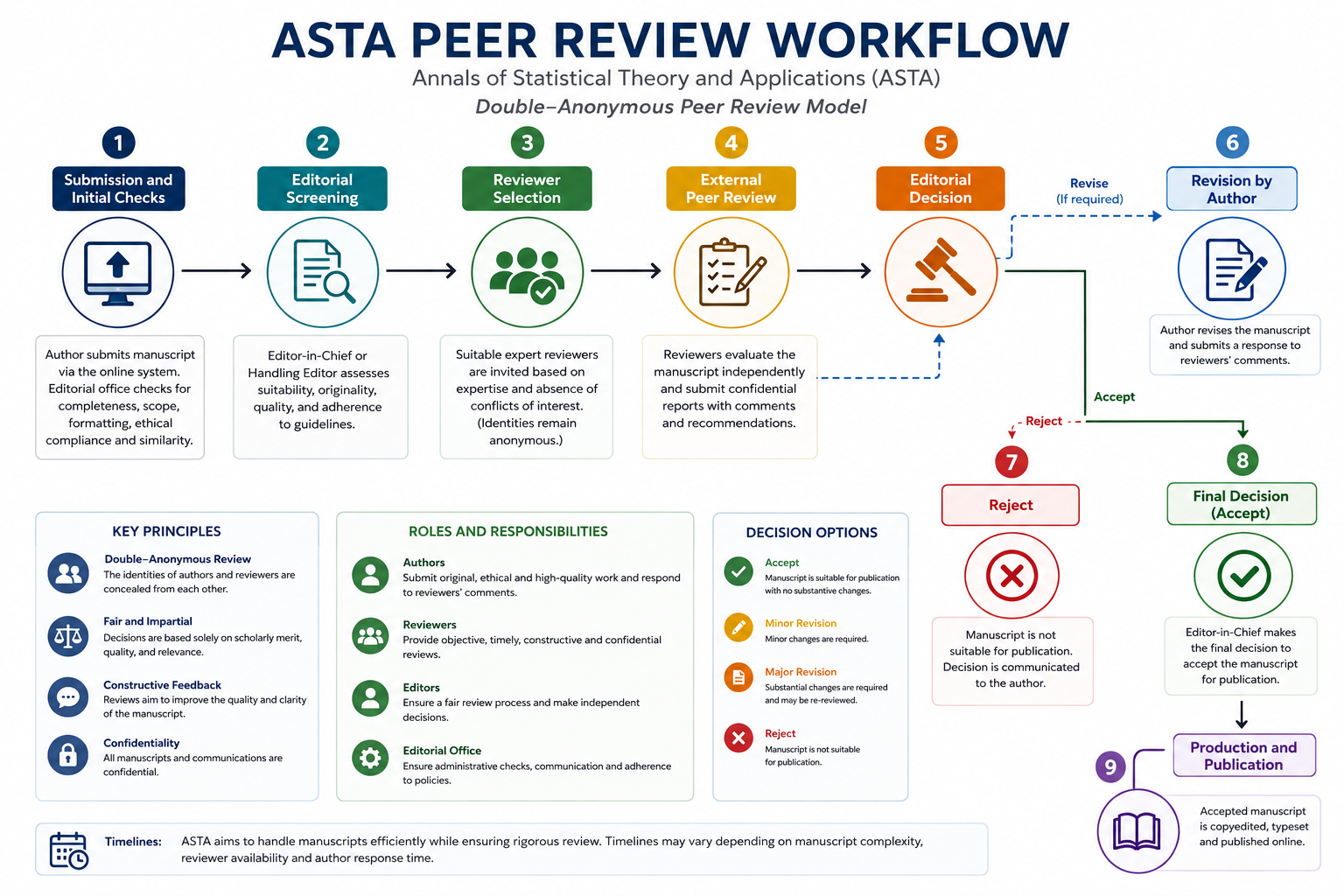
All manuscripts submitted to ASTA undergo the following stages.
Stage 1: Submission and Initial Checks
Manuscripts are submitted through the journal's online submission system. The editorial office conducts an initial technical and administrative check to determine whether the submission:
-
Contains the required files and information.
-
Follows the journal's submission requirements.
-
Falls within the journal's scope.
-
Meets basic formatting and presentation requirements.
-
Contains sufficient information for editorial assessment.
-
Satisfies applicable ethical and publication requirements.
Where appropriate, manuscripts may also undergo plagiarism or similarity screening.
Stage 2: Editorial Screening
The Editor-in-Chief or an assigned editor evaluates the manuscript for suitability before external peer review.
The editorial assessment considers:
-
Alignment with the journal's aims and scope.
-
Originality and potential contribution.
-
Scientific and methodological quality.
-
Clarity of presentation.
-
Appropriate use of statistical methods.
-
Compliance with ethical and publication requirements.
A manuscript may be rejected at this stage if it is clearly outside the journal's scope, lacks sufficient scholarly contribution, has serious methodological deficiencies, or fails to meet essential submission requirements.
Stage 3: Reviewer Selection
Manuscripts that pass editorial screening are assigned to appropriate independent reviewers.
Reviewers are selected based on:
-
Subject and methodological expertise.
-
Relevant research experience.
-
Publication or scholarly expertise in the manuscript's area.
-
Availability to complete the review within the required timeframe.
-
Absence of conflicts of interest.
Authors may suggest potential reviewers during submission, but the final decision regarding reviewer selection rests with the editorial team.
Stage 4: External Peer Review
Reviewers independently evaluate the manuscript and provide a confidential report to the editor.
Reviewers are normally expected to assess:
-
Originality and significance.
-
Theoretical contribution.
-
Methodological rigour.
-
Statistical validity.
-
Appropriateness of data and analytical methods.
-
Interpretation of results.
-
Reproducibility and transparency where applicable.
-
Quality of tables, figures, and mathematical presentation.
-
Clarity and organisation.
-
Adequacy of references.
-
Overall contribution to the field.
Reviewers should provide constructive, specific, and evidence-based comments that can help authors improve their work.
4. Reviewer Responsibilities
Reviewers are expected to:
-
Maintain confidentiality throughout the review process.
-
Provide objective and independent assessments.
-
Declare any actual, potential, or perceived conflict of interest.
-
Decline a review when they lack the necessary expertise or cannot complete it within the required timeframe.
-
Identify relevant published work that may have been overlooked by the authors where appropriate.
-
Avoid using information obtained through peer review for personal or professional advantage.
-
Avoid personal, discriminatory, offensive, or irrelevant comments.
-
Distinguish between major scientific concerns and minor editorial issues.
-
Submit their review within the agreed deadline.
Reviewers should not contact authors directly about a manuscript under review unless authorised by the editorial team.
5. Editorial Decisions
Following peer review, the editor evaluates the reviewers' reports together with the manuscript and makes an editorial decision.
The possible decisions are:
Accept
The manuscript is considered suitable for publication with no substantive changes required. Minor editorial corrections may still be requested during production.
Minor Revision
The manuscript is potentially publishable but requires limited revisions. The revised manuscript may be assessed by the editor or returned to the reviewers as appropriate.
Major Revision
The manuscript requires substantial changes before a final publication decision can be made. A revised manuscript may undergo another round of external peer review.
Reject
The manuscript is not considered suitable for publication in ASTA. Rejection may result from insufficient originality, methodological weaknesses, lack of contribution, inappropriate scope, ethical concerns, or other substantial deficiencies.
A request for revision does not guarantee eventual acceptance.
6. Revision and Resubmission
When revisions are requested, authors should submit:
-
A revised version of the manuscript.
-
A detailed response to the reviewers' comments.
-
A clear indication of the changes made in the manuscript, where requested.
Authors should address each substantive reviewer comment and provide a reasoned explanation where a suggested change is not adopted.
Revised manuscripts may be returned to the original reviewers or assessed by members of the editorial team, depending on the nature and extent of the revisions.
7. Final Editorial Decision
The Editor-in-Chief or designated handling editor makes the final editorial decision after considering the manuscript, reviewer reports, author responses, and any subsequent revisions.
Editorial decisions are based on the scholarly merits of the manuscript and its suitability for the journal. Acceptance is not determined solely by the recommendation of an individual reviewer.
The journal may seek additional reviews when reviewer reports substantially disagree or when specialist expertise is required.
8. Confidentiality
Manuscripts submitted to ASTA, reviewer reports, editorial correspondence, and other materials associated with the peer-review process are treated as confidential.
Reviewers must not:
-
Share manuscripts or review materials with unauthorised individuals.
-
Discuss manuscripts under review with third parties.
-
Use unpublished information obtained through peer review for personal or professional purposes.
-
Disclose the identity of authors or other reviewers where the double-anonymous review model applies.
The editorial team will disclose confidential information only where necessary for legitimate editorial, ethical, legal, or publishing purposes.
9. Conflicts of Interest
Editors and reviewers must disclose any circumstances that could reasonably affect their impartiality.
Potential conflicts may include:
-
Recent collaboration with an author.
-
Current or recent institutional affiliation.
-
Personal or professional relationships.
-
Direct competition involving closely related research.
-
Financial or commercial interests.
-
Other circumstances that could compromise objective assessment.
A reviewer who has a significant conflict of interest should decline the review invitation.
Authors are also required to disclose relevant conflicts of interest in accordance with the journal's submission requirements.
10. Reviewer Recommendations and Editorial Independence
Reviewer recommendations are advisory. The final publication decision rests with the Editor-in-Chief or designated editor.
Editors may accept, reject, or request revision regardless of an individual reviewer's recommendation when justified by the overall evidence and scholarly assessment.
Editorial decisions must not be influenced by:
-
Author nationality or ethnicity.
-
Gender or personal characteristics.
-
Institutional prestige.
-
Political considerations.
-
Commercial interests.
-
Financial relationships.
-
Personal relationships.
11. Appeals
Authors who believe that an editorial decision resulted from a significant procedural error, misunderstanding of the manuscript, or demonstrably inappropriate consideration may submit a formal appeal to the Editor-in-Chief.
An appeal should:
-
Identify the manuscript.
-
Clearly state the decision being appealed.
-
Provide specific and substantive reasons for the appeal.
-
Address relevant factual or procedural concerns.
Disagreement with an editorial decision alone is not normally sufficient grounds for an appeal.
Appeals will be considered independently of the original decision where appropriate. The Editor-in-Chief may seek advice from another editor or an independent reviewer when necessary.
The outcome of an appeal is normally final.
12. Complaints
Complaints concerning the peer-review process, editorial conduct, reviewer behaviour, or other publishing matters should be submitted to the Editor-in-Chief or the journal's designated contact.
Complaints will be handled confidentially and investigated fairly in accordance with the journal's publication ethics procedures.
Where a complaint concerns the Editor-in-Chief, the matter should be referred to an appropriate senior representative of the Professional Statisticians' Society of Nigeria or another designated independent authority.
13. Peer Review and Research Integrity
Peer review is one component of the journal's broader commitment to research integrity. The journal reserves the right to investigate concerns relating to:
-
Plagiarism.
-
Fabrication or falsification of data.
-
Duplicate or redundant publication.
-
Manipulation of images or results.
-
Inappropriate authorship.
-
Undisclosed conflicts of interest.
-
Ethical approval and research conduct.
-
Manipulation of the peer-review process.
Where misconduct is established, the journal may take appropriate action, including rejection, correction, retraction, or notification of relevant institutions or authorities.
14. Use of Artificial Intelligence in Peer Review
Reviewers must not upload confidential manuscripts, unpublished data, reviewer reports, or other protected editorial materials to publicly accessible generative artificial intelligence systems or other third-party tools where doing so could compromise confidentiality.
Reviewers remain fully responsible for the content, accuracy, and confidentiality of their review reports.
Any use of artificial intelligence or automated tools in the review process must comply with the journal's confidentiality, research integrity, and data protection requirements.
15. Review Timelines
ASTA aims to process manuscripts efficiently while maintaining rigorous peer-review standards. Reviewers are normally provided with a defined period within which to complete their assessments.
Actual processing times may vary depending on:
-
Availability of suitable reviewers.
-
Reviewer response times.
-
Manuscript complexity.
-
Number of review rounds required.
-
Author revision time.
-
Editorial workload.
The journal may invite additional reviewers when necessary to obtain an appropriate and sufficiently informed assessment.
16. Post-Publication Review
Peer review does not end the journal's responsibility for maintaining the integrity of the published record.
ASTA welcomes legitimate scholarly concerns about published articles. Where significant errors, ethical concerns, or evidence of misconduct are identified after publication, the journal may investigate the matter and publish an appropriate correction, retraction, expression of concern, or other editorial notice.
17. Commitment to Fair and Rigorous Review
ASTA is committed to conducting peer review in a manner that is fair, confidential, constructive, and scientifically rigorous. The journal recognises peer review as a shared scholarly responsibility involving authors, reviewers, and editors.
By submitting a manuscript to ASTA, authors acknowledge and agree to the journal's peer-review procedures and related publication policies.
Peer Review Model at a Glance
Submission → Initial Checks → Editorial Screening → Reviewer Selection → External Peer Review → Editorial Decision → Revision, where required → Final Decision → Production and Publication
Possible editorial outcomes include:
Accept | Minor Revision | Major Revision | Reject
The journal may repeat the review and revision stages when necessary to ensure that manuscripts meet the journal's scholarly and methodological standards.